Tuesday, March 30, 2010

ABC Wednesday

K is for Kokanee


If you are a quick listener this video about salmon spawning is most interesting, - if not, relax and enjoy the scenery and the picture images.

The Okanagan and North Thompson areas in British Columbia are famous for their spawning streams and rivers.  In September and October each year the local creeks, such as the one in Hardy Falls National Park near Peachland, are bright with  Kokanee returning to their place of birth to spawn, and then to die.


Creeks of all sizes are full of this desperate stream of fish, struggling against the flow to reach their spawning grounds.


The Adams River, which flows out of the Adams lake is home to the worlds largest Sockeye and Kokanee salmon run. 


A watchful eye is kept on the returning salmon run, and when it is at its peak in September or October the riverbank is crowded with onlookers to this most amazing and colourful migration.


This is not an easy journey and there are many obstacles in the way of the homecoming fish.  To assist the Kokanee and other salmon to reach their destination 'fish ladders' have been built and installed in especially difficult spots.

Fish Ladders on the Fraser River
Fish ladders built on the Fraser River have enabled millions of salmon to overcome a physical barrier, demonstrating the value of fish ladders as an effective way to modify dams. Though the Fraser River mainstem has never been dammed, human carelessness caused a near-blockage of the river in 1913. In that year, rock debris from railway construction at Hell's Gate stopped thousands of salmon from travelling up the Fraser's mainstem to spawn. Salmon runs on the Upper Fraser were decimated in the years that followed. In 1946, Canadian and American funds were used to build elaborate fish ladders at Hell's Gate, which saved many runs from extinction and allowed fish stocks to rebuild. Though the ladders were built to overcome a human blunder, they illustrate the good that can come when people intervene to improve fish passage upstream. Thanks in part to these efforts, the Fraser is still the greatest salmon river on earth.

from the Internet....

On a more personal note, amongst the first stories Charles told me about his home and the Okanagan Valley was the autumn adventures on small spawning streams that flowed from the hills of the Okanagan into the lake.

They called the fish 'Kickaninnies', and if the creek was small enough the boys could stand with a foot on each side and bending over scoop up the fish with their hands.

For more stories about the letter K visit here, at ABC Wednesday.
Fish ladders on the Fraser River at Hell's Gate.
Fish ladders on the Fraser River at Hell's Gate. (Photo: Rick 

Sunday, March 28, 2010


A bit of this, a bit of that...

I am at the door this afternoon, camera in hand, and I call to the man in the back room "I am just going out to take some pictures while the sun is shining".

Down the stairs and six steps along through the garden, and the sun disappears behind a cloud - wispy in spots, but not where the sun is now!

Three days left in March, and recalling the lamb-like way the month entered it is quite apparent March is calling up its most lion like demeanor to make a roaring exit.

Neverthless, it has been rather a sweet month and spring has taken advantage of this and established residence, at least for a time.

Eventually the cloud that hid the sun drifted off and I was able to snap the apricot blossoms and the spring-clad trees, as well as a few pictures of Life in the Garden.


The tree at the bottom of the lane


Early spring bloom on the Apricots


Buds on a bleeding heart


The Hellebores prepare to say goodbye while the Perennial Alyssum  can hardly wait to burst into bloom.


As I was coming home from church this morning Sid and Sharon and the two dogs and their dear grandson, Corbin, were out chasing the wind around, throwing a bright red ball which Corbin and the dogs retrieved enthusiastically - the dogs had the advantage, but I think Corbin had the most fun.

Or maybe Grandma and Grandpa did????

I get to play the organ on Easter Sunday (and on Good Friday too) and I have been vacillating between practicing sombre music and joyous preludes.

I found a wonderful version of 'Morning has Broken' in the stacks of old music and thought it might make a nice Postlude change from the Messiah Hallelujahs.

And considering This and That, I am really pleased that Blogger has made new templates available, and love the one I have chosen.  For now, anyway.  There is a nice varied choice and I am finding it easy to manipulate images - check it out.

If (when) Charles continues with his blog of early days I will treat him to a look see and update

'From the Back Pasture'.


Thursday, March 25, 2010

Skywatch Friday

A picture from the past.

A summer sky in the Similkameen.


More sky pictures from around the world here, at Skywatch Friday.

Wednesday, March 24, 2010


The Colours of Spring

It is late in the afternoon when I suggest to Charles that we make a foray into Spring and discover how the season progresses down the Valley (where it is a smidgen earlier and where the buttercups and yellowbells first dot the hills).

We turn left at the end of the lane, on to the highway, but at the first opportunity we take a side road that follows the river to Cawston.

We round the corner by the park, where a forsythia bush is glowing in the afternoon sun,


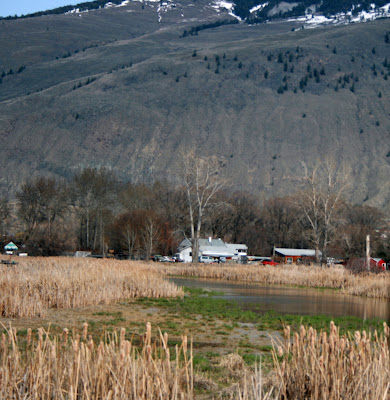
and take the road down to Ginty's Pond.


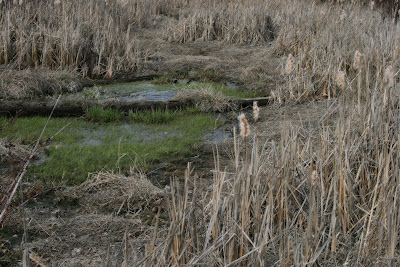
The sun catches the disintegrating bullrushes with a luminous glow

as if they were held from below as fairy flares.


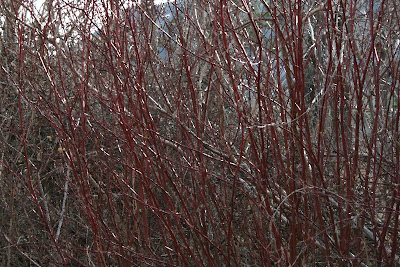
The road is lined with scarlet willow


until we come to an open patch of meadow on the left,

where the sap is rising sweetly in the shrubs

that border the pond.


As we turn at the end of the road the hills across the river

fold green above us.


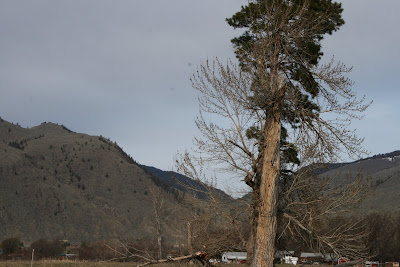
and an old gnarled evergreen dominates the pasture beneath it


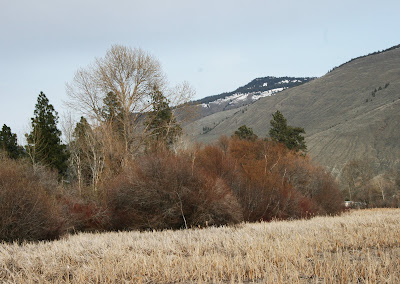
More gloriously vibrant shrubs align the
bullrushes that clog the water


Great tall trees in the midst of dressing themselves in Spring's tender greenery


and then a radiant grove of birch, smooth as satin
and intertwined with red willow


A last glimpse of the brilliant new growth in the pond

and two nesting Teals


and we turn and follow the road to the Upper Bench

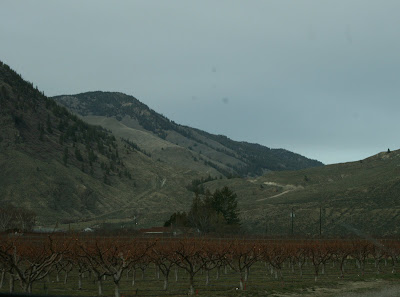
where the peach trees are promising an imminent show of pink blossoms

and the hills are green and verdant.


As we drive through the orchards blocks of apricot trees

are blooming tentatively in the face of a late spring frost.


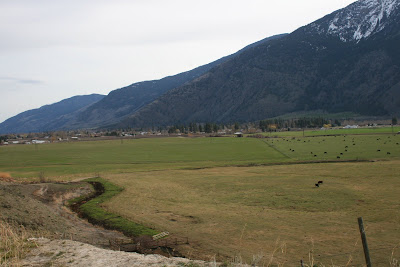
We go the long way home and stop to watch the calves below us

where the fields are green and the creek snakes along the edge


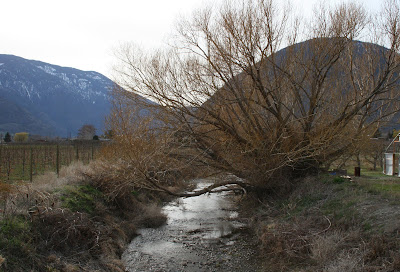
We turn back to the highway, crossing a small bridge that spans the creek.

The willows that follow its course are as spectacular today

as they were in all their fall finery, and the dried grasses whisper in the spring breeze.


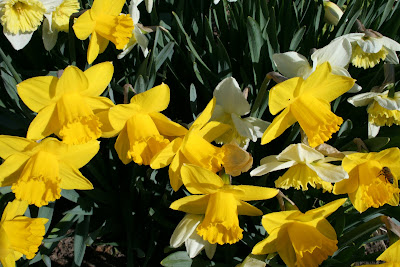
We come home to happy hour and the gold of daffodils


and a lovely hour of piano music provided by

our oldest son, who followed us up the lane!

And full of awe at the stirrings of life and the beauty

that accompanies it.

Tuesday, March 23, 2010

ABC Wednesday

J is for Jabberwocky.

The poem

'Twas brillig, and the slithy toves
Did gyre and gimble in the wabe;
All mimsy were the borogoves,
And the mome raths outgrabe.

"Beware the Jabberwock, my son!
The jaws that bite, the claws that catch!
Beware the Jubjub bird, and shun
The frumious Bandersnatch!"

He took his vorpal sword in hand:
Long time the manxome foe he sought—
So rested he by the Tumtum tree,
And stood awhile in thought.

And as in uffish thought he stood,
The Jabberwock, with eyes of flame,
Came whiffling through the tulgey wood,
And burbled as it came!

One, two! One, two! and through and through
The vorpal blade went snicker-snack!
He left it dead, and with its head
He went galumphing back.

"And hast thou slain the Jabberwock?
Come to my arms, my beamish boy!
O frabjous day! Callooh! Callay!"
He chortled in his joy.

'Twas brillig, and the slithy toves
Did gyre and gimble in the wabe;
All mimsy were the borogoves,
And the mome raths outgrabe.


The Glossary for this 'glorious nonsense' poem which Lewis Carroll included in his tale of Alice, "Through the Looking Glass" can be found here. and more wonderful interpretations of the splendid letter 'J' can be found here at ABC Wednesday, hosted by Mrs. Nesbitt and her kind helpers.

Saturday, March 20, 2010


The full Rainbow as taken by David, our son - a supplement to Skywatch Friday posting.

Do click to enlarge and enjoy.

Friday, March 19, 2010

Making over the Garden or What C.A. and Cam accomplished in one Short Day

Well, it was a sweet, pale sunrise, - nothing spectacular or flashy - just an endearing and demure beginning to what the weatherman promised would be a pleasant day.


We lingered over breakfast, waiting for Cam and Cindy Anne to arrive with their garden gloves and shovels, - a lovely gesture from our oldest granddaughter and her husband.

And when they came what miracles they performed. One forgets how energetic the forties are, - how easy it is to dig and and how speedy it is divide the plants and conquer the coutch grass and the underground Chinese Lantern Subway when the roots of its line show up....


Cindy Anne digs up the Barn Flower


Divides it, and puts it into plastic bags - some to take home,

some to entice other people to plant it in their gardens....

and some Cam and Charles transplanted to other parts of the garden.


After lunch we divided and bagged up some more perennials

to give the garden plants room to expand.

And then we went and gathered up

the two table looms

for C.A. and one of her students,

both of them eager to weave

and me,

so happy to send them where they will be used

and cherished and bring two more weavers

into the fold!!

And the dear girl relieved me of some of the wool stash too!!!

Altogether a most satisfactory day.


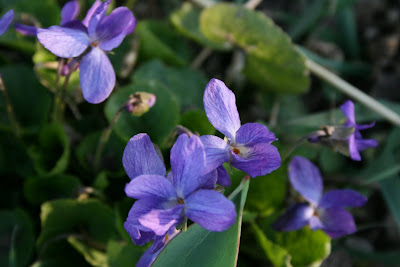
I took some pictures of the daffodils and violets and the emerging blooms

on the forsythia


The rest of the eager and vibrant plants

I will put here

In the Garden Diary.

Thursday, March 18, 2010

Skywatch Friday
March 19th, 2010

A progressive rainbow in the Similkameen.....

It is a dark day, promising nothing but clouds and rain and wind.

I look up from the sink full of soapy water, off to the north where the sky is lighter than it is in the south, - and there it is.

A lovely bright rainbow hugging the tops of the mountains. By the time I get the camera it has lost some of its brilliance.


This is a catch as catch can show and progressively it gets fainter as the moments pass.


A few hundred yards down the hill our son was able to capture the complete rainbow, stretching close to the horizon across the northern end of the valley.

Lovely way to start the day!


For more interesting skies visit here, at Skywatch Friday.

Tuesday, March 16, 2010

ABC Wednesday

I is for Inch Worm


Visit ABC Wednesday here to see what else 'I' represents, with thanks to Mrs. Nesbitt and her kind helpers.

Monday, March 15, 2010


Closing the Circle

I spent a few hours this afternoon out with the looms and the wool stash and all the bits and pieces that weavers need in their business. Shuttles and heddles and ball winders and threaders, beaters and spindles and swifts and books. A goodly shelf of books, and a whole cupboard of Handwoven and Spin-Off magazines.

And the stash, - great huge see through containers and baskets and bags, all stuffed full of thin wool, thick wool, silks and cottons. Cones and thrums and pre-wound warps - and all of them speaking of a half a lifetime of weaving.

I was just past the first flush of family when I became passionate about weaving. The sheep we had were inspiring, and I tied fleeces willingly at shearing time in order to save the longest and finest and prettiest for my new spinning wheel and the dyepot that accompanied it.

I gathered dye materials from the hills and the garden and the grocery store. I experimented with mordents and was fascinated by the gorgeous and varied shades they produced.

I bought an Inkle loom and we made frame looms of different sizes, - I read everything I could get my hands on to learn the intricacies of more advanced weaving, and as I did so I shared the knowledge with others who were full of enthusiasm too. There were no local Weaving Guilds but for a few years there were others who were excited about weaving on primitive looms, and we shared what we knew.

Probably the flower children who worked in our orchard and the turnip field passed along more ways of doing things and more delightful ideas for what to weave and how to do it.

Finally I bought my first table loom, - a LeClerc Dorothy, and then a jack loom that opened the window wide on blankets and scarves and tablecloths and light rugs and I was in my glory....

After we moved from the farm to the village Charles and I bought an eight harness countermarche loom, and he became a very important part of the weaving studio with such wonderful inventiveness and practical wood working. He made sectional beams for both the floor looms and creels and the most ingenious tensioner and a counter for winding bobbins. We had as great room on the lower floor that accommodated both the floor looms and equipment, and a spare bedroom for the ever growing stash of wool.

Ah, now we come to the crux of the matter, - that enormous stash of wool that filled my dreams with plans for projects, - all sorts of intricate patterns and threadings and treadlings and all these yarns would eventually be woven into beautiful weavings.

Alas, time and energy seem to sometimes be at cross purposes with our dreams, and sometimes dreams turn into stress that lies unconscious under all our plans.

And so I have come to this time when I must face reality and share all the yarns (except for some lovely silk that I may take to the grave with me!) with younger, more energetic people who are knitters or weavers or crocheters, but who all cherish the passion for fabric or creating.

I have found an eager home for two table looms and all their accoutrement's. My knees outgrew the countermarche a few years ago when lying on the floor tying up heddles was no longer exciting, but almost impossible. Someone is coming to take away the rug wools and warps, and I know that shoppers at the Bargain Centre will be happy with my other yarn offerings.

I will keep my first Jack Loom - it is warped and anxious to have a lovely weft flying back and forth. And besides, Charles has not yet made that fly shuttle that he planned, just for the satisfaction of creating it....

The circle holds so many memories, and I will close it to where I first started, holding the memories safe and sure and secure within its lovely bounds.

Thursday, March 11, 2010

Skywatch Friday
March 10th, 2010


Sunrise in the Similkameen

For more skies from around the world visit here.

Tuesday, March 09, 2010

ABC Wednesday

H is for Hellebore


These are the Hellebores that live in our garden, and who, as we speak, are preparing themselves for a second night of -5C weather under a star filled sky.

And here are a lot of interesting facts and myths about Hellebores through the ages, - perhaps more than you ever wanted to know, but they are a lovely and welcome flower when winter is coming to an end.

From Wikipedia.......

Hellebores are widely grown in gardens for decorative purposes, as well as for their purported medicinal abilities and uses in witchcraft. They are particularly valued by gardeners for their winter and early spring flowering period; the plants are surprisingly frost-resistant and many are evergreen. Many species of hellebore have green or greenish-purple flowers and are of limited garden value, although Corsican hellebore (H. argutifolius), a robust plant with pale green, cup-shaped flowers and attractive leathery foliage, is widely grown. So is stinking hellebore or setterwort (H. foetidus), which has drooping clusters of small, pale green, bell-shaped flowers, often edged with maroon, which contrast delightfully with its dark evergreen foliage. H. foetidus 'Wester Flisk', with red-flushed flowers and flower stalks, is becoming popular, as are more recent selections with golden-yellow foliage.
The so-called Christmas rose (H. niger), a traditional cottage garden favourite, bears its pure white flowers (which often age to pink) in the depths of winter; large-flowered cultivars are available, as are pink-flowered and double-flowered selections.

The most popular hellebores for garden use, however, are undoubtedly H. orientalis and its colourful hybrids (H. × hybridus). They flower in early spring, around the period of Lent, and are often known as Lenten hellebores, oriental hellebores, or Lenten roses. They are excellent for bringing early colour to shady herbaceous borders and areas between deciduous shrubs and under trees.

In the early days of medicine, two kinds of hellebore were recognized: black hellebore, which included various species of Helleborus, and white hellebore, now known as Veratrum album ("false hellebore"), which belongs to a different plant family, the Melanthiaceae [3]. Although the former plant is highly toxic, containing veratrine and the teratogens cyclopamine and jervine, it is believed to be the "hellebore" used by Hippocrates as a purgative. California corn lily is similar in appearance to V. album and has sometimes been mistaken for it.[citation needed]
"Black hellebore" was used by the ancients in paralysis, gout and other diseases, more particularly in insanity. "Black hellebore" is also toxic, causing tinnitus, vertigo, stupor, thirst, a feeling of suffocation, swelling of the tongue and throat, emesis and catharsis, bradycardia (slowing of the pulse), and finally collapse and death from cardiac arrest.[4] Although Helleborus niger (black hellebore or Christmas rose) contains protoanemonin[5], or ranunculin,[6] which has an acrid taste and can cause burning of the eyes, mouth and throat, oral ulceration, gastroenteritis and hematemesis[7], research in the 1970s showed that its roots do not contain the cardiotoxic compounds helleborin, hellebrin, and helleborein responsible for the lethal reputation of "black hellebore". It seems that earlier studies may have used a commercial preparation containing a mixture of material from other species such as H. viridis, green hellebore.[8]

Several legends surround the hellebore; in witchcraft it is believed to have ties to summoning demons. Helleborus niger is commonly called the Christmas rose, due to an old legend that it sprouted in the snow from the tears of a young girl who had no gift to give the Christ child in Bethlehem.

In Greek mythology, Melampus of Pylos used hellebore to save the daughters of the king of Argos from a madness, induced by Dionysus, that caused them to run naked through the city, crying, weeping, and screaming.

During the Siege of Kirrha in 585 BC, hellebore was reportedly used by the Greek besiegers to poison the city's water supply. The defenders were subsequently so weakened by diarrhea that they were unable to defend the city from assault.
Some historians believe that Alexander the Great died because of a hellebore overdose, when he took it as medication.


For more posts on H visit here at ABC Wednesday, with thanks to Mrs. Nesbitt and her kind helpers.

Monday, March 08, 2010

Bits and Pieces - A day in March

On nice days, when the sun is shining and the wind is resting in the hills we go out into the garden, knowing full well that March will visit us with cold and blustery days while Spring goes calling elsewhere.

Today was such a day, - nice warm temperature but the wind came in gusts when Caspar and I went out early this morning, blowing his newly shampooed coat in little curly swirls and my hair into wild disarray.


(a windswept dog from Flickr, but he could be Caspar's cousin)


(windswept hair from heaven knows where)

This was definitely not a garden day. After breakfast and a little visit and gossip with our youngest daughter Charles retired to the mud room and his project for the day, whilst I examined some oranges that seemed to be losing some of their freshness and decided on Orange Muffins to cheer up the day in general and coffee time in particular.


It wasn't a 'wash the inside windows' day, either, - mainly because I was tired and not inclined that way. So I read a little bit. Bonnie Burnard's first novel and Giller Prize book 'A Good House'. The Montreal Gazette says of this book "It's the small details, bits of ordinary life, that make this story real. These are the kinds of characters we can't help growing attached to; we wish them well and worry for them-een after we've set Burnard's book aside...Burnard is such an accomplished story-teller that she manages to blur the line between fact and fiction."

I have recently read Burnard's latest novel, "Suddenly" and I found the story and the matter of fact way of telling it equally compelling. She brings her characters to life, and they occasionally reminds you of someone you knew, someone you met or someone you loved.

When my eyes got tired and lost their focus I picked up my knitting. This will be the eighth sock in the Christmas series, - as elegant as a work sock can be in black with white toe and heel and one discreet stripe up near the top.

Charles appeared out of the mudroom some time around twelve, - went to hang on his inversion table (stretches the back) and I made a lazy lunch of toasted mushroom soup sandwiches (deliciously easy, - daughter's recipe).

A little nap, a quick trip to town to get groceries and birdseed, and before one could say Jack Robinson it was happy hour!

When Caspar and I went out again before supper the wind was back in hiding and it was pleasant as we passed the garden, - I was wont to bend over and dislodge a little coutch grass from around the chrysanthemums, but further thought made me decide they were going to have to be dug up, the coutch grass was going to have to be painstakingly removed from the roots and the surrounding soil, and then they could be replanted (the chrysanthemums, - not the coutch grass - although you can bet your bottom dollar that some wee snippets of grass will slip into the pristine soil to start next year's crop).

Will it be this pleasant in the morning? Even if it is, alas it will not be a garden day as The Ladies are coming for lunch - which means it will be just as pleasing and fun besides. The Ladies are all widows and old friends, so Charles' presence at lunch always adds a certain welcome masculinity, and he is ever gallant and ever entertaining. A little spice to the gathering....